Basic digital marketing is no longer about broadcasting messages into an endless stream of content and hoping someone notices. It has evolved into something more refined, more intelligent, and more human at the same time. We are operating in an era where artificial intelligence filters information before people ever see it, where algorithms predict intent before users finish typing, and where attention is earned through relevance rather than volume. Yet despite all this sophistication, the core objective of digital marketing remains unchanged: connecting the right message to the right person at the right time.
Over the past decade, many have predicted the death of SEO and even the decline of digital marketing itself. But what has actually happened is a transformation. Search has expanded into discovery. Social platforms have turned into commerce engines. AI has shifted from being a novelty to becoming an infrastructure layer that supports nearly every marketing action. The marketers who succeed in 2026 are not those who shout the loudest. They are those who understand how to combine automation with authenticity, data with empathy, and technology with trust.
In this guide, we will walk you through basic digital marketing in 2026 in a clear, practical, and grounded way. If you are a beginner trying to understand where to start, or a business owner looking to adapt to the current landscape, you will find a structured path forward. Digital marketing tools may have changed, but the principles are still accessible. When you understand the foundations, you can build confidently, no matter how the platforms evolve.
Basic Digital Marketing
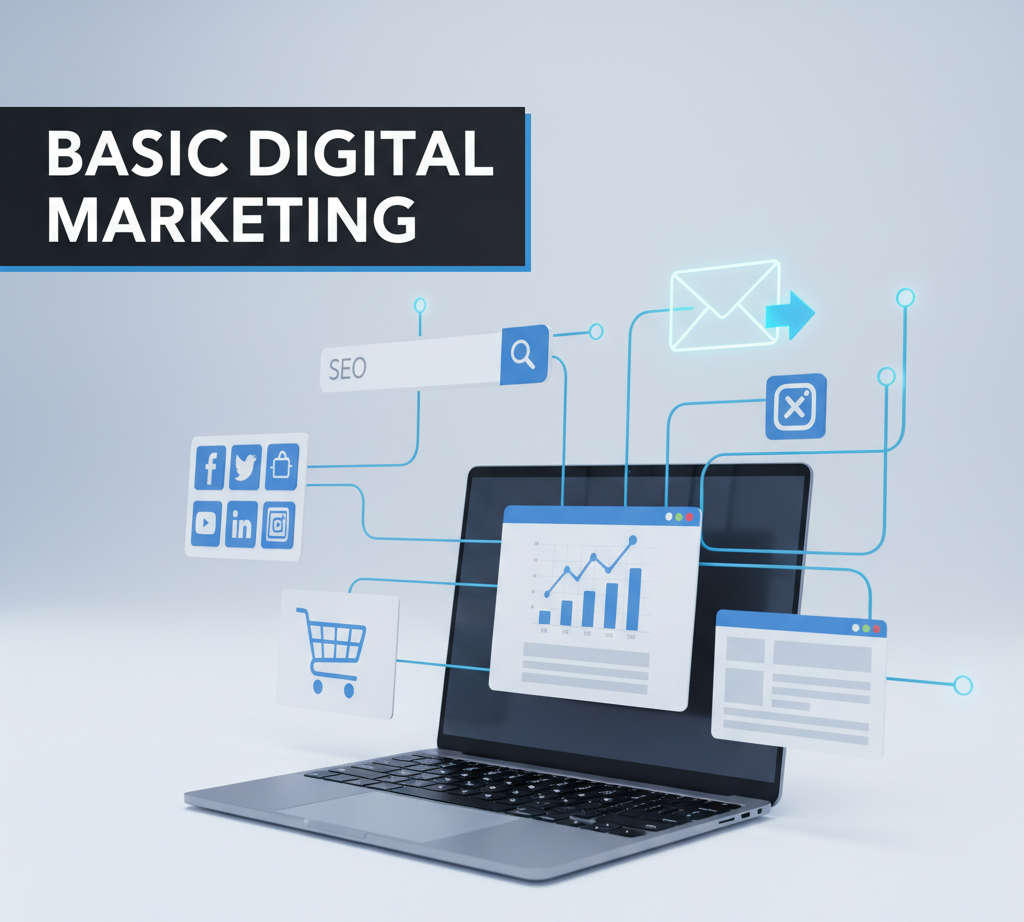
To understand basic digital marketing today, you must first recognize how discovery works in 2026. A few years ago, most journeys began with a traditional search engine query. A user typed a keyword into Google, clicked a blue link, and explored a website. Today, that journey often begins inside an AI-generated overview, a chatbot interface, or a social media search bar. People discover products through recommendation engines, short-form videos, voice assistants, and AI agents that summarize content before presenting it.
Search has not disappeared, but it has become more layered. Instead of simply ranking web pages, search engines now generate answers. AI assistants interpret questions, pull information from multiple sources, and deliver synthesized responses. This shift has led to the rise of what many now call Generative Engine Optimization, a natural evolution of traditional SEO. Instead of optimizing only for rankings, marketers now optimize for inclusion in AI-generated responses.
At the same time, social platforms have matured into full business ecosystems. A user can discover a product on a short video, read reviews in the comments, click through to a storefront, and complete a purchase without ever leaving the app. The funnel is compressed. Awareness, consideration, and purchase can happen within minutes.
Despite all these changes, one thing stands out clearly. Human-first content performs best. Content created solely by AI, without real experience or perspective, often feels generic. Algorithms have become increasingly capable of detecting depth, originality, and credibility. In 2026, authenticity is not optional. It is a ranking factor, a conversion driver, and a trust signal.
The Core Pillars of Basic Digital Marketing
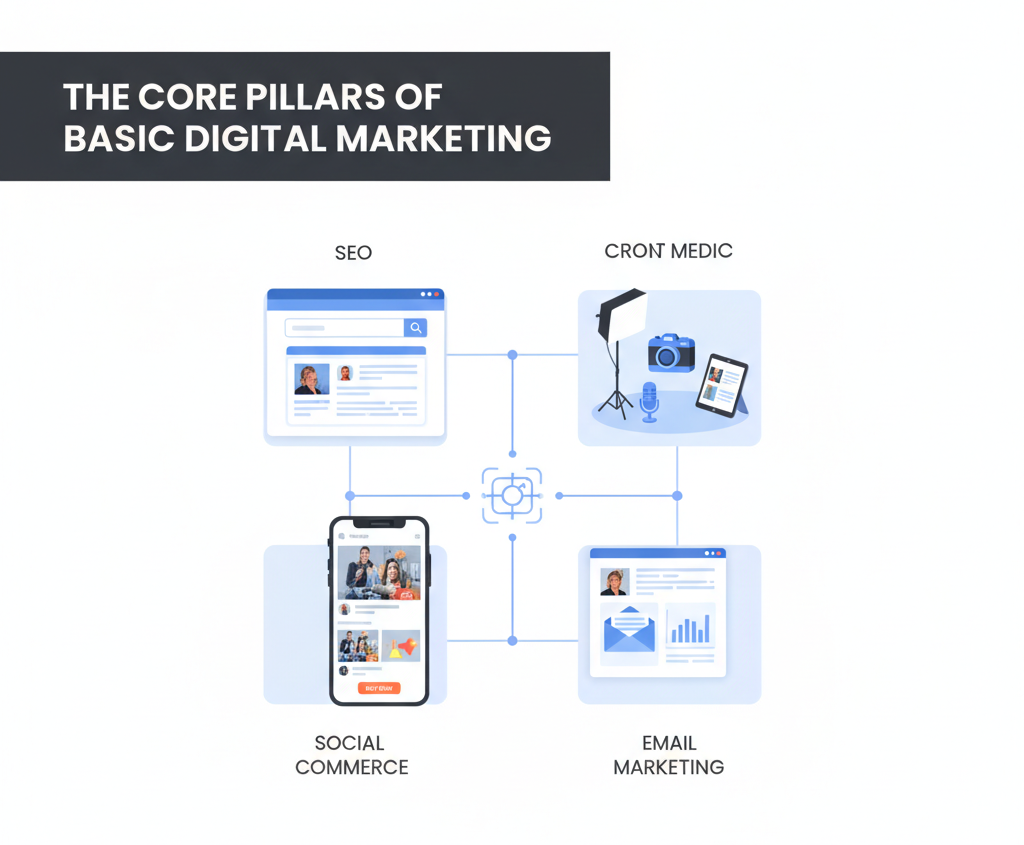
To truly master basic digital marketing in 2026, you must understand the four interconnected pillars that shape the modern landscape: search and discovery, social commerce, the owned ecosystem, and content as experience. These pillars do not operate independently. They reinforce each other, and when aligned correctly, they create a sustainable and scalable digital marketing system.
Let us break each one down in a practical, real-world way so you can clearly see how they function in action.
#1. Search and Discovery: From Keywords to Intent and AI Recommendation Systems
Search and discovery are no longer limited to typing phrases into Google and scrolling through blue links. In 2026, discovery happens inside AI summaries, voice assistants, social search bars, and recommendations by search engines like Google. While keywords still play a role in basic digital marketing, intent now carries more weight than exact phrasing.
AI systems analyze context rather than isolated terms. For instance, when someone searches for “how to start a small food business with low capital,” the algorithm does not simply match those words. It evaluates intent. Is the user researching? Planning? Ready to invest? Looking for local regulations? The AI then surfaces content that comprehensively answers those layered needs.
Consider a real-world example. Imagine you run a blog that teaches entrepreneurship. Instead of publishing a short 600-word article stuffed with the phrase “start food business,” you publish a 2,500-word guide that covers startup costs, required permits, supplier sourcing, marketing strategies, and profit margins. You include real case studies and structured headings. Over time, search engines begin to recognize your site as authoritative on small business startup topics. When AI-generated summaries pull content to answer users’ questions, your brand becomes part of the recommended sources.
That is the shift in basic digital marketing. You are not optimizing to rank. You are optimizing to be recommended by AI systems that synthesize answers for users. This requires clear structure, logical formatting, topical consistency, and depth. It also requires building authority over time by publishing related content clusters that reinforce your expertise.
Discovery also happens inside platforms like YouTube and TikTok. Users search directly within these apps. If someone types “best budgeting apps for students” into a social platform’s search bar, the algorithm ranks videos based on watch time, engagement, and keyword relevance in captions and titles. In this environment, strong content combined with smart optimization increases discoverability without traditional website SEO alone.
Basic digital marketing in 2026 requires thinking like both an educator and a strategist. You must anticipate what your audience truly wants to solve, not just what they type.
#2. Social Commerce: From Entertainment to Integrated Marketplaces
Social commerce represents one of the most significant evolutions in digital marketing. Platforms that were originally built for connection and entertainment now function as end-to-end sales funnels.
A user might watch a short video reviewing skincare products, scroll through comments to see real customer feedback, tap a product link within the app, and complete the purchase without ever leaving the platform. Discovery, consideration, and transaction happen in one seamless experience.
Let us look at a practical example. A small fashion brand launches a short-form video demonstrating how to style one dress in five ways. The video gains traction because it provides immediate value. Viewers save it, comment on it, and share it. The brand responds to comments with direct product links. Because the platform supports in-app checkout, interested buyers can purchase instantly. There is no friction of redirecting to external websites or filling long forms.
This illustrates why social media is no longer just for brand awareness. It is a primary revenue channel. In basic digital marketing, ignoring social commerce means ignoring direct buying behavior.
However, one of the biggest misconceptions beginners have is believing that follower count equals success. In reality, engagement quality matters far more. A brand with 5,000 highly engaged followers who actively comment and trust recommendations can outperform a brand with 100,000 passive followers who rarely interact.
Community drives conversions. When people trust you, they do not need aggressive sales tactics. They respond to recommendations naturally. In 2026, successful digital marketing strategies prioritize building relationships over accumulating vanity metrics.
#3. The Owned Ecosystem: First-Party Data as a Strategic Asset
As privacy regulations strengthen globally and third-party cookies continue to decline, the value of first-party data has increased dramatically. First-party data refers to information you collect directly from your audience, such as email addresses, purchase history, and engagement behavior.
In basic digital marketing, your owned ecosystem includes your website, email list, SMS list, and any platform where you directly control communication. Unlike social media algorithms, which can reduce your organic reach overnight, your email list remains stable and accessible.
Consider a practical scenario. A content creator has 50,000 social media followers but no email list. One day, the platform changes its algorithm, reducing organic reach by 60 percent. Traffic drops, sales decline, and growth stalls. Now imagine another creator with only 10,000 followers but an email list of 8,000 subscribers. When they launch a product, they send a personalized email sequence directly to subscribers. Open rates average 30 percent, and conversion rates reach 5%. Even with a smaller social presence, the owned ecosystem generates predictable revenue.
This is why high-performing digital marketing strategies in 2026 always prioritize capturing and nurturing first-party data. Offering lead magnets such as free guides, checklists, or exclusive webinars encourages users to subscribe. Once inside your ecosystem, automation sequences can provide value consistently.
Email marketing has experienced a resurgence precisely because it bypasses algorithmic interference. When executed properly, it delivers one of the highest returns on investment in digital marketing. Automated welcome sequences introduce your brand. Educational newsletters build trust. Segmented promotions target specific interests. Even simple campaigns can produce measurable and repeatable income.
Basic digital marketing requires understanding that attention borrowed from social platforms should be converted into owned attention wherever possible.
#4. Content as Experience: From Information to Interaction
The final pillar is content as experience. In earlier years, publishing articles alone was often enough. Today, audiences expect more dynamic interactions. They want visual demonstrations, interactive tools, short-form educational videos, and storytelling that feels authentic.
For example, instead of writing a static article about calculating business profit margins, you could embed a simple calculator tool that allows users to input their revenue and expenses. Instantly, the content becomes interactive. Users spend more time on the page, engagement signals improve, and the likelihood of sharing increases.
Short-form video also plays a critical role. Suppose you are teaching basic digital marketing strategies. You publish a 60-second video explaining how email automation works, then direct viewers to a detailed blog guide for deeper learning. The short video captures attention quickly, while the long-form content builds authority.
Real case studies further enhance content experience. If you explain how a small online store increased conversions by improving product descriptions and adding customer reviews, readers see proof rather than theory. Stories anchor abstract concepts in reality.
Content in 2026 must deliver value quickly while encouraging deeper exploration. This layered approach mirrors how people consume information today. They skim first, then dive deeper when interested.
When these four pillars work together, basic digital marketing becomes a cohesive system rather than scattered tactics. Search and discovery bring new audiences. Social commerce converts attention into sales. The owned ecosystem builds long-term stability. Content as experience strengthens engagement and trust.
Digital marketing is sophisticated, but with this basic structure in mind, it becomes clearer. Focus on intent over keywords. Build community over vanity metrics. Capture first-party data to secure your growth. And create content that feels useful, interactive, and human. When you approach basic digital marketing with this integrated mindset, you are not merely participating in trends. You are building a resilient strategy designed to adapt and thrive.
Mastering the New SEO: From Keywords to Authority
Traditional SEO focused heavily on keywords, backlinks, and technical optimization. While those elements still matter, authority and experience now play a central role. Search engines evaluate credibility through a concept often summarized as experience, expertise, authoritativeness, and trustworthiness. This means demonstrating real-world knowledge rather than rewriting generic advice.
If you are teaching digital marketing, for example, share real examples. Explain what worked for you, what failed, and what you learned. Cite data responsibly. Show evidence of practical application. When algorithms detect unique insights and consistent topical focus, they reward it.
Structured data has also become more important. By implementing schema markup and organizing your content clearly, you help AI systems understand your pages. This increases the likelihood of being featured in AI-generated responses. Clear headings, concise summaries, and logical content flow improve machine readability while also enhancing user experience.
Social SEO is another dimension of basic digital marketing that many beginners overlook. Platforms like YouTube and TikTok function as search engines in their own right. Users search for tutorials, product reviews, and solutions directly within these apps. Optimizing titles, descriptions, captions, and on-screen text improves discoverability. Consistency and engagement signals further strengthen visibility.
Social Media: Community Over Virality
In previous years, virality was often seen as the ultimate goal. A single viral post could generate massive reach. However, mass reach without trust rarely converts into sustainable growth. In 2026, community-driven digital marketing outperforms vanity metrics.
Building a loyal audience requires conversation rather than broadcasting. Respond to comments thoughtfully. Encourage feedback. Create spaces where your audience can interact with each other. Private groups, messaging communities, and live sessions foster deeper relationships.
Short-form video has become the standard format for micro-learning. People consume educational content in small, digestible segments. If you can explain a concept clearly in under a minute, you capture attention. This does not replace long-form content; it complements it. Short videos attract interest, while detailed articles and guides provide depth.
Collaborating with micro-creators is also powerful. Smaller creators often have niche authority and highly engaged audiences. Partnerships built on authenticity outperform generic advertisements. Trust is transferable when collaboration feels natural.
The Essential Tech Stack for Beginners for Basic Digital Marketing.
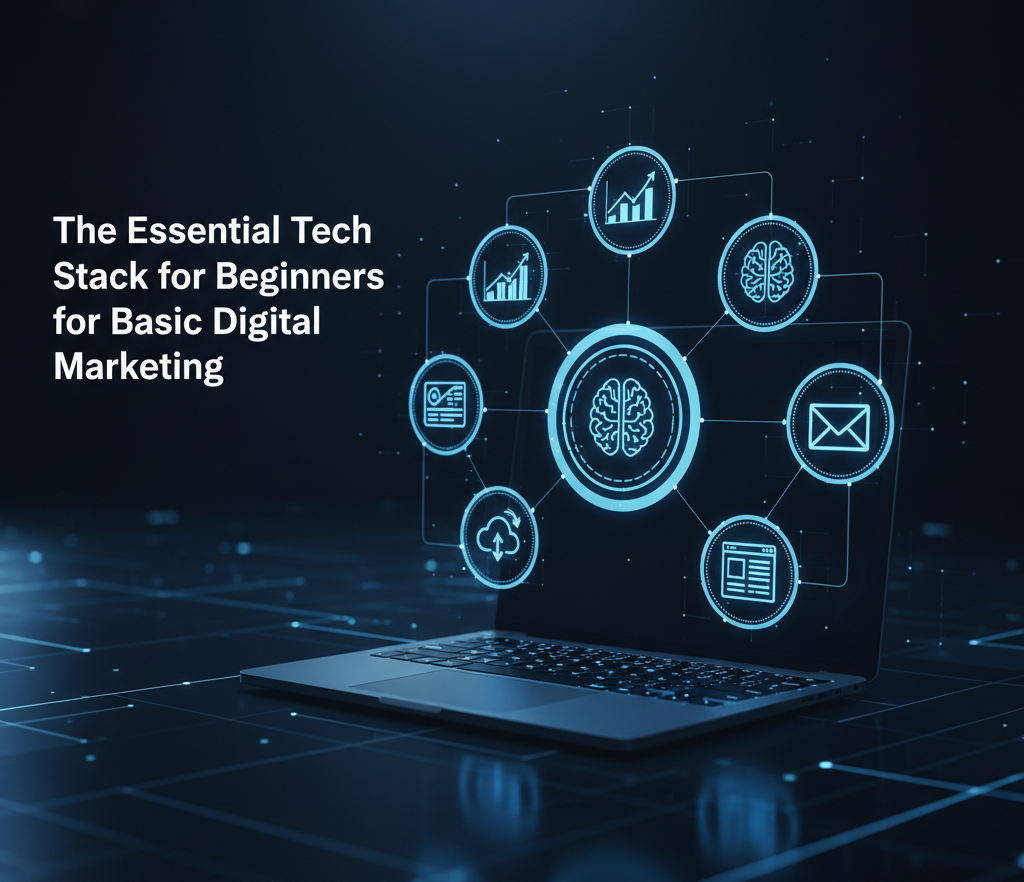
Technology should enhance your strategy, not complicate it. Beginners often feel overwhelmed by the number of tools available. The key is simplicity. Start with essential components and expand gradually.
AI writing assistants can help with outlining, research, and brainstorming. However, they should not replace your voice. Use AI tools to accelerate workflow while ensuring your content reflects personal insight and clarity. Human editing is crucial.
Automation tools allow you to send targeted messages based on behavior. For example, when someone downloads a guide from your website, an automated email sequence can provide additional value. This makes communication feel timely and relevant.
Analytics has evolved beyond counting clicks. Attribution models now analyze multiple touchpoints before a conversion. Understanding which channel influenced a purchase helps you allocate resources effectively. Even at a basic level, tracking traffic sources and engagement patterns gives you actionable insights.
90 Days in Basic Digital Marketing
If you are starting from scratch, focus on building a solid foundation. In your first month, establish your core assets. Create a simple but professional website. Define your brand perspective clearly. Identify the specific audience you want to serve and the problems you aim to solve.
In the second month, shift toward discovery. Publish consistent content aligned with search intent. Experiment with short-form videos to distribute your ideas. Encourage visitors to subscribe to your email list. This phase is about visibility and initial traction.
In the third month, analyze performance data. Identify which topics generate engagement. Notice which platforms drive meaningful traffic. Refine your strategy accordingly. Optimization is not about drastic changes. It is about incremental improvements informed by data.
Throughout this process, remember that basic digital marketing is a long-term endeavor. Results compound over time. Consistency outweighs intensity.
Conclusion: Basic Digital Marketing
As advanced as technology has become, empathy remains the differentiator. AI can generate content, analyze trends, and automate workflows, but it cannot replicate genuine understanding. When you prioritize helping people solve real problems, you align naturally with the principles of effective digital marketing.
Today, the most successful brands are those that combine intelligence with integrity. They use AI to scale efficiency while maintaining authentic communication. They build owned ecosystems to protect their reach. They create content experiences that educate, inspire, and convert.
If you focus on mastering these fundamentals, you will not need to chase every new trend. Basic digital marketing is not about constant reinvention. It is about adapting core principles to evolving platforms. Learn how discovery works, build authority, nurture community, leverage technology wisely, and measure what matters.
The digital landscape will continue to evolve, but the businesses that understand these foundations will remain resilient. When you approach digital marketing with clarity, strategy, and empathy, you position yourself to thrive.