Welcome back to our blog, your trusted source for real-world strategies that help you take control of your time, your income, and your financial future. Here, we believe that building sustainable online income isn’t just possible, it’s accessible to anyone with the right tools, mindset, and guidance. We cover topics around RR, MRR, PLR, and practical digital strategies to make money with resell rights products.
Some of our most popular posts: passive income stream with resell rights, Things you must do before selling PLR products, How to use facebook ads and google ads to sell digital products, Dropshipping vs digital products, 10 best digital products to sell, Ecommerce and selling strategies, , Best payment gateways for digital product store, Affiliate marketing vs selling digital products, How to Generate PLR Content with AI, How AI is Reshaping Digital Products and PLR, Best AI Tools for Automating Digital Product Sales
Today, we’re unpacking one of the most overlooked but highly effective methods for generating revenue. This article will walk you through how to think about promoting MRR products with social ads in 2025, why it works, how to set it up, and how to scale without blowing your budget.
Marketers are increasingly turning to master resell rights (MRR) products as a high-leverage, low-investment opportunity. When paired with smart social advertising, the formula can deliver impressive returns with minimal budget, maximum impact.
What Are Social Ads and How Do They Work?
Social ads are paid posts you see on platforms like Facebook, Instagram, TikTok, or LinkedIn. They look like regular posts but have a small “Sponsored” tag — meaning someone paid to show them to you.
Here’s how they work: Businesses create an ad, set a goal (like more sales or website visits), choose their audience, and set a budget. The platform then shows the ad to people most likely to be interested.
You can target by age, location, interests, or behavior. The system runs your ad, tracks how people react, and adjusts to get better results over time.
It’s simple: You pay → your ad appears → people click → you get leads or sales.
Social ads work so well because they’re affordable, targeted, and measurable — perfect for anyone trying to grow a business or promote digital products without breaking the bank.
Understanding How MRR Products and Social Ads Work
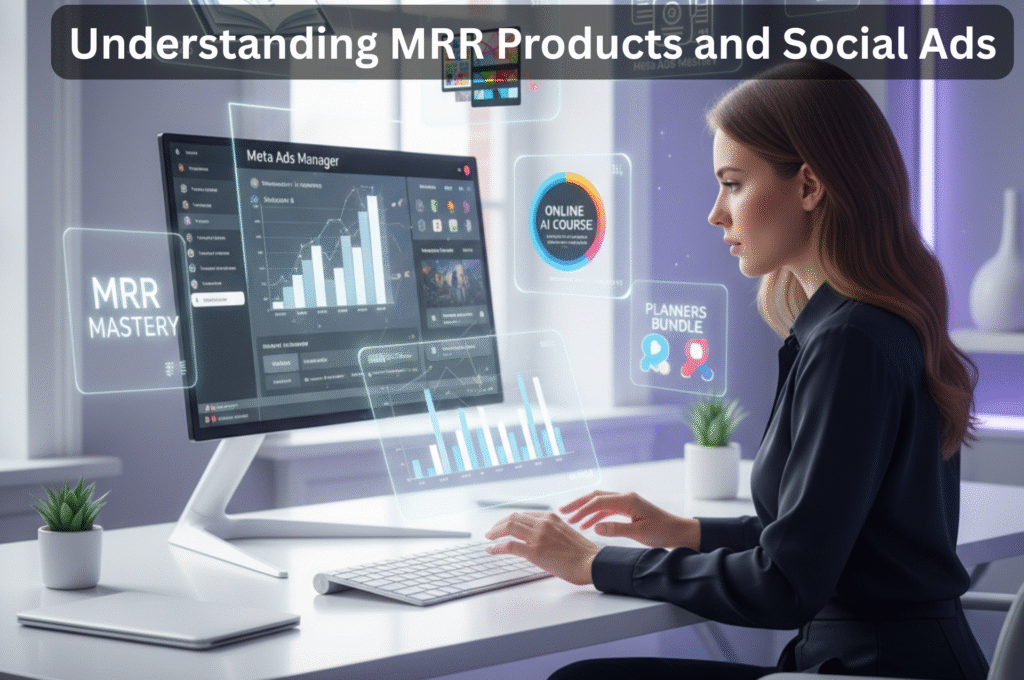
When you think about “promoting MRR products with social ads”, you are combining two powerful elements. On one side, you have a product model where you can acquire digital products (templates, ebooks, courses, etc.) that come with “master resell rights” (MRR)—meaning you have the right to resell the product and keep 100 % of the profit. On the other side, you have social ads—paid media on platforms like Facebook, Instagram, TikTok, LinkedIn, or X (formerly Twitter)—which allow you to reach targeted audiences with budget precision.
The beauty of this combination in 2025 is that you can start with a relatively low-cost product (digital product development is cheap) and then amplify reach with smart social ads. Because the cost of delivering ads has stabilised (and in some markets risen), you need to make sure that your product margins, ad targeting, and conversion funnel are tightly aligned. According to earlier paid-social data, spending on display & paid social grew significantly (for example, in Q1 2020, ad spend rose, although CPMs increased).
For a digital marketer on a small budget (such as start-up agencies, affiliate marketers, and small business owners), “promoting MRR products with social ads” offers a path to recurring revenue, because once you set up your MRR product and funnel, each additional sale costs less than the first. The objective is not just a one‐time purchase but multiple revenue streams from one content asset, plus reuse of ads or variants.
It’s worth noting that MRR products themselves often come with ready-made marketing assets (sales pages, email swipes, banners). For example, some bundles include “buy once, sell forever” rights. That means your focus shifts more to traffic and optimisation (via social ads) rather than product creation. The synergy is clear: low product cost, flexible rights, scalable traffic.
How to Set Up a Low-Budget Social Ads Funnel for MRR Products
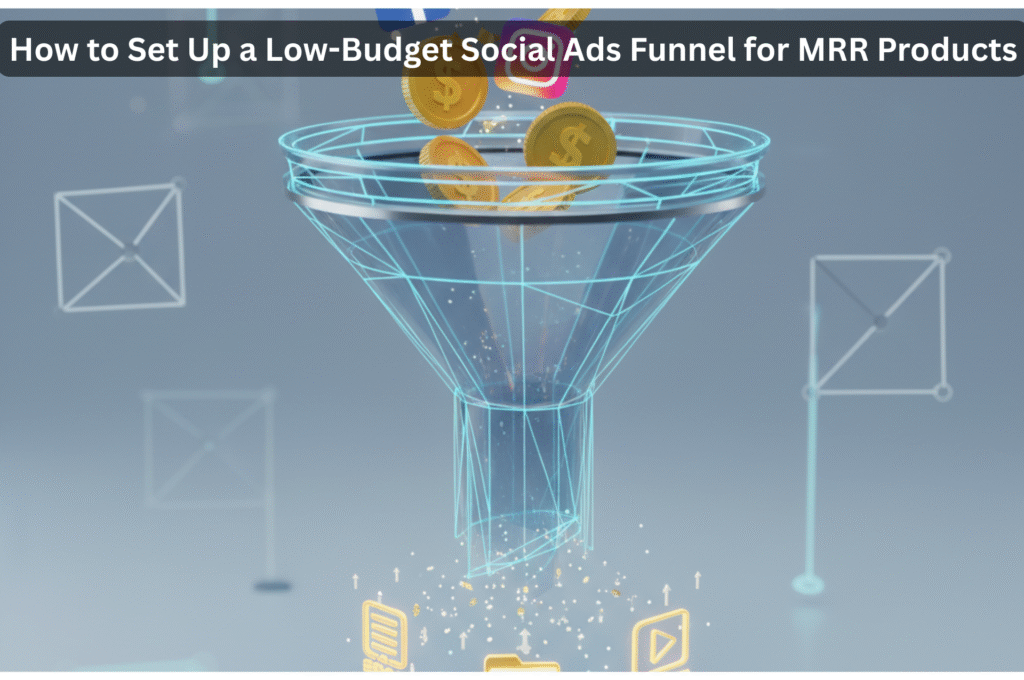
To execute “promoting MRR products with social ads” on a shoestring budget, you must be strategic. Here’s a walk-through of the essential steps.
#1. Define the product & offer: Start by choosing your MRR product carefully. It should solve a clear problem for a defined audience, have perceived high value, and allow for a clear sales funnel (e.g., low-priced entry, upsell, optionally a recurring element). Because you’ll be spending ad money, the conversion rate must justify the spend. For example, a digital product bundle that you can resell many times gives you leverage.
#2. Know your audience: Identify the ideal buyer persona for that product. Ask: Who benefits from this MRR product? What platforms do they use? What pain points do they have? For example, if your MRR product is a social media template bundle, your target might be solopreneurs on Instagram or agencies needing quick content assets. Once you have clarity, you can use social ad targeting effectively: choose interest targeting, lookalikes, and platform placement (stories, reels, feed).
#3. Craft your ad creative & messaging: Because your budget is low, you’ll want high-impact ad creative. Use strong visuals, concise copy, clear benefit statements, and a single strong call to action (CTA). Because the objective is to sell, not just generate awareness, your ads must lead directly to a relevant offer page. You can use the marketing assets bundled with many MRR products—modify them if needed to align your branding.
#4. Select the right platform & placements: Different social platforms offer different cost profiles, audience behaviours, and placement types. For instance, Instagram Reels or TikTok might be more cost-effective to test for younger audiences, while Facebook feed may work better for slightly older small business owners. Keep your budget small at first: perhaps $5-10 per day for test campaigns. Monitor cost per click (CPC) and cost per acquisition (CPA). Diversify across placements, but initially pick one or two to keep control.
#5. Build a conversion-focused funnel: Your funnel should be tightly optimised: ad → landing/sales page → checkout. Because you’re reselling the product, ensure the checkout process is frictionless. Track conversions, and make sure the cost of the ad does not exceed the lifetime value of the sale (or at least the initial sale). Because this is “low budget, high impact”, you must maximise your cost efficiency. Use social ad analytics to make data-driven decisions: pause underperforming ads, scale winners.
#6. Use retargeting and lookalike audiences: Once you start getting traffic, use retargeting to bring back visitors who didn’t convert. Use lookalike audiences based on your buyers. This helps “promoting MRR products with social ads” become more efficient over time: ad costs often drop when optimisation improves.
#7. Analyse & optimise: Check metrics: CTR (click-through rate), conversion rate, CPA, ROI. For a low-budget campaign, you may allow a higher CPA but track lifetime value (LTV). Use A/B testing for creatives, ad copy, and landing pages. Over time, shift spend from underperforming ad sets to those delivering the best return.
Maximising Impact on a Micro-Budget

With a limited budget, you need to squeeze every dollar (or naira) for maximum return. Here are advanced tactics to help you optimise “promoting MRR products with social ads” even when spending is minimal.
#1. Leverage urgency and scarcity: Because you’re often selling digital products, you can add one-time offers, bonuses, and limited-time deals. This increases the conversion rate, which means you get more value from each click. Combine this with your social ad message to push action.
#2. Offer value first: Rather than pushing a hard sell immediately, you might run a low-cost lead magnet (free or low cost) to build your list, then upsell the MRR product. This lowers your risk because the ad cost is partially offset by building a relationship. However, if your product margin is high, you can also send traffic directly.
#3. Use platform features for low-cost reach: For example, on Instagram or Facebook, you might use stories, reels, or short video ads, which often generate cheaper CPCs than standard feed ads. Try vertical format videos, dynamic creative, carousel ads. These give better engagement for small budgets.
#4. Scale carefully: Once an ad set is profitable, double the daily budget gradually (e.g., +20-30 %) rather than a sudden jump. This avoids throwing off the platform algorithm and avoids sudden cost increases. Monitor CPA as you scale. If CPA rises, revert or refine.
#5. Reuse and repurpose creatives: With a micro budget, you cannot continuously create new creatives. Instead, reuse your best performing ads, change small elements (headline, CTA, image) to refresh. Because the MRR product allows unlimited resale, it makes sense to reuse assets and reinvest savings into ad spend.
#6. Leverage social proof and urgency in ads: If you already have sales and testimonials, incorporate them into your ads and landing page. Social proof increases conversion rate, which makes your ad spend more efficient. If you don’t yet have testimonials, consider offering early buyers a bonus or discount in exchange for a testimonial.
#7. Track all costs and understand breakeven: Because your budget is small, you must know exactly how many sales are needed to break even on ad spend (CPA number of conversions). Then you aim for above-break-even margin. Your profit margin = product sale price minus any cost (ad spend + fees). Ensure you’re not selling at a margin so thin that you cannot sustain ad spend.
Common Pitfalls & How to Avoid Them

Even when you are promoting MRR products with social ads wisely, there are many mistakes marketers make. Here are some to watch for.
#1. Bad product/offer-market fit: If the MRR product you promote does not resonate with your audience, you’ll burn money on ads. Make sure your product solves a real problem and your ad message reflects that solution. Don’t jump in just because the rights are cheap.
#2. Ignoring conversion tracking: Without reliable conversion tracking (via pixels, UTM parameters, third-party tracking) you cannot know what ads are working. If you run ads without data, you risk wasting spend.
#3. Spending too much too soon: If you launch a high budget without testing, you may waste money on poorly performing creatives. Start small, optimise, then scale.
#4. Over-complicating the funnel: A complex funnel with too many steps or distractions will lower conversion rate, which increases your CPA. Especially on a micro budget, you want a simple, lean funnel.
#5. Ignoring ad fatigue: Even if an ad performs well initially, over time, the CTR and conversion rate will drop. Regularly refresh ads, rotate creatives, and monitor fatigue. Because you’re on a tight budget, you cannot afford a drop in performance unnoticed.
#6. Not accounting for platform changes and competition: Ad costs, platform algorithms, and audience behaviour change. What worked in 2023 may not work in 2025. Always test and adapt. For example, new features (short-form video, enhanced messaging) might give you a low-cost advantage if you jump early.
#7. Failing to nurture customers and upsell: You may get a sale of an MRR product, but you could miss the opportunity to upsell, cross-sell, or build a list from that buyer. Without follow-up, you lose long-term value and reduce return on ad spend.
Trends and Scaling MRR with Social Ads

When you think forward about “promoting MRR products with social ads” in 2025 and beyond, you’ll want to consider trends and how to scale your efforts responsibly.
#1. Short-form video dominance: Platforms such as TikTok, Instagram Reels, and YouTube Shorts continue to dominate attention. Running short, punchy ads with a social-native feel will help you reduce costs per click and increase engagement. If your product lends itself to quick benefit messaging, use these placements.
#2. Messaging and conversational commerce: Ads that move users into messaging apps (WhatsApp, Messenger) or in-app chatbots often convert better because they create a personal connection. Integrating ads that drive to a conversation, rather than just a landing page, may become more cost-efficient.
#3. AI-powered creative optimisation: You will find more platforms providing dynamic creative, automatic optimisation, and AI-generated ad assets. Use those features to test variants of your ad copy, image, video, and placement—so you get more value from your budget.
#4. Subscription-style upsell models: Rather than just one-time purchases, many digital product sellers are moving toward subscription/recurring models (memberships, coaching, asset refresh). If you can convert your MRR product into a subscription funnel (for example, monthly updates, bonus materials), your return on ad spend improves, and your budget can scale.
#5. Global and niche targeting: Because you are based in Lagos (Nigeria) and looking at African markets (if applicable), you may find lower CPCs and less competition in certain geographies. Consider targeting emerging markets with social ads, adjusting for local currency and buying power. Often, micro budgets go further in such markets.
#6. Careful scaling and automation: Once you have a winning ad funnel for your MRR product, you can scale by increasing budget, expanding placements, or replicating campaigns for variations of the product. But scale smartly: maintain CPA, monitor return, and automate repetitive tasks (campaign duplication, reporting, retargeting sequences).
#7. Build a brand around your MRR funnel: Even though MRR products are resell rights, you can still brand your funnel, create credibility, and build a reputation. Over time, the brand recognition reduces your CPA (because users click with more trust), and you can leverage email remarketing, referral programmes, and affiliate partners to drive traffic without additional ad cost.
Conclusion: Promoting MRR Products with Social Ads
The phrase “promoting MRR products with social ads” encapsulates a high-leverage strategy for digital marketers who are budget-conscious but growth-oriented.
Some of our most popular posts: passive income stream with resell rights, Things you must do before selling PLR products, How to use facebook ads and google ads to sell digital products, Dropshipping vs digital products, 10 best digital products to sell, Ecommerce and selling strategies, , Best payment gateways for digital product store, Affiliate marketing vs selling digital products, How to Generate PLR Content with AI, How AI is Reshaping Digital Products and PLR, Best AI Tools for Automating Digital Product Sales
By selecting the right MRR product, crafting a lean funnel, using smart social ad strategy, optimising continuously, and avoiding common pitfalls, you can build a recurring revenue machine with minimal upfront investment. The key is to treat each ad spend as an investment: track conversions, monitor cost, scale winners, and iterate. With discipline and strategy, a micro budget need not mean micro results.